Prepos, hooray! Today, we are going to be all over the place: we’ll be “in”, “auf”, “vor”, “neben”, “unter” (in, on, in front of, next to, under/ below) ... you name it!
Our topic is...
prepositions taking the Accusative and/ or the Dative case.
So strap on your inflatable armbands and let’s jump into the pool of prepositions. It’s time to get this party started!
The Accusative Case - Review
Before you fill up your party cups, let’s review the Accusative case so you can set your focus and be ready to glide onto the prepositions dance floor.

Seid ihr bereit für die Präpositionen-Party?!
I’m assuming you have already covered the Accusative case. Otherwise, you probably wouldn’t be here flirting with prepositions.
The Accusative is used
- after certain verbs and
- after certain prepositions.
For the grammar nerds among you:
- The Accusative case often refers to the direct object in an English sentence, and
- it’s the person or thing that the verb is happening to.
Example:
- Ich kaufe den Pullover. (I'm buying the sweater.)
Here, “der Pullover” is our direct object and the verb “kaufen” indicates that we have to
use the Accusative.
Do you know any other verbs that take the Accusative? Don’t worry, I will give you a few examples in case you don’t remember!
The verbs could be:
- brauchen (to need): Ich brauche einen Salat. (At the market: I need a lettuce.)
- sehen (to see) Ich sehe einen Salat. (I see a lettuce.)
- kaufen (to buy) Ich kaufe den Salat. (I buy the lettuce.)
- nehmen (to take) Ich nehme einen Salat. (At the restaurant: I'll take a salad. / I’ll have a salad.)
- haben (to have) Ich habe den Salat. (I have got the salad.)
... and many more. About 95% of German verbs with an object take the Accusative case.

Da haben wir den Salat!
Idiom: Didn't I tell you? (Or, literally: Here we have the salad = the mess.)
Wanna exercise the Accusative verbs? Check out Anja’s video with the most common verbs!
Native speakers also have a few magic questions that they can use to help identify the Accusative case: “Wen?” (who) and “was?” (what).
However, these questions don’t really make a lot of sense if you’re not super deep into the language, so don’t focus on them too much.
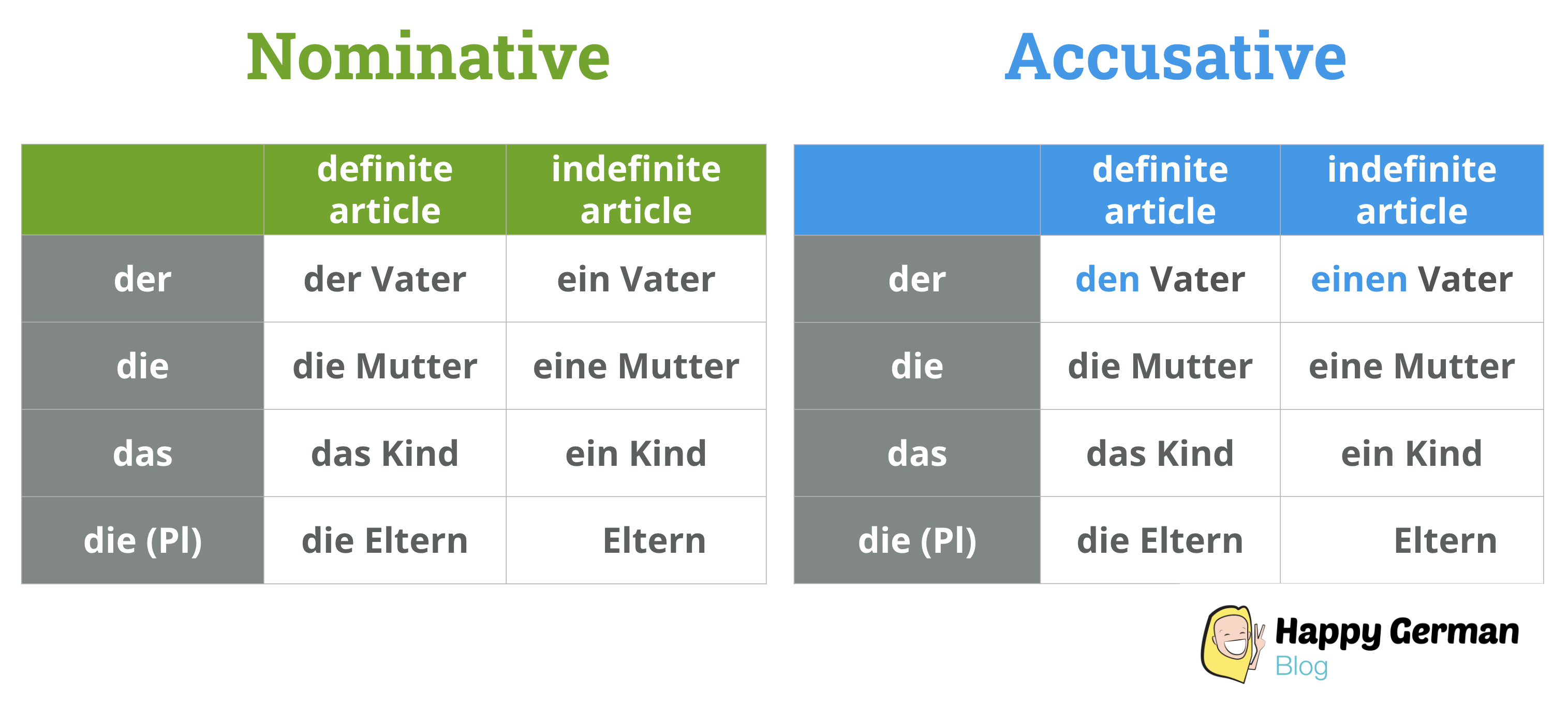
In the Accusative case, there are some changes to the articles that we have to memorize. Luckily, they only happen to masculine nouns in their singular form and their respective articles. (We have a lot more changes in the other cases.  )
)
Check the changes to the articles from Nominative to Accusative case in the grid below:

The Dative Case - Review
The Dative case can be a little trickier, but don’t worry, we’ll help you master it.
In an English sentence, it is mostly referred to as the “indirect object”.
→ You can recognize it by the sentence structure or an addition like “to” or “from”, usually followed by a person.
The most important thing and the key to handling the Dative case - just like the Accusative - is:
The Dative is used
- after certain verbs and
- after certain prepositions.
Example:
- Ich fahre mit dem Auto. (I’m going by car. Literally: I am driving with the car.)
In the Nominative case, “Auto” has the article “das”. But because
→ we have a preposition, in this case “mit”, in front of the noun,
→ we change "das Auto" to the Dative case “dem Auto”.
Here’s another example:
- Er glaubt mir. (He believes me.)
Here we have the Dative pronoun “mir” which would be “ich” in the Nominative case.
→ Since “glauben” is a verb that takes the Dative, the pronoun changes from “ich” to “mir”.
There are some more verbs that need the Dative case. We cover those verbs in our post on the most common Dative verbs.
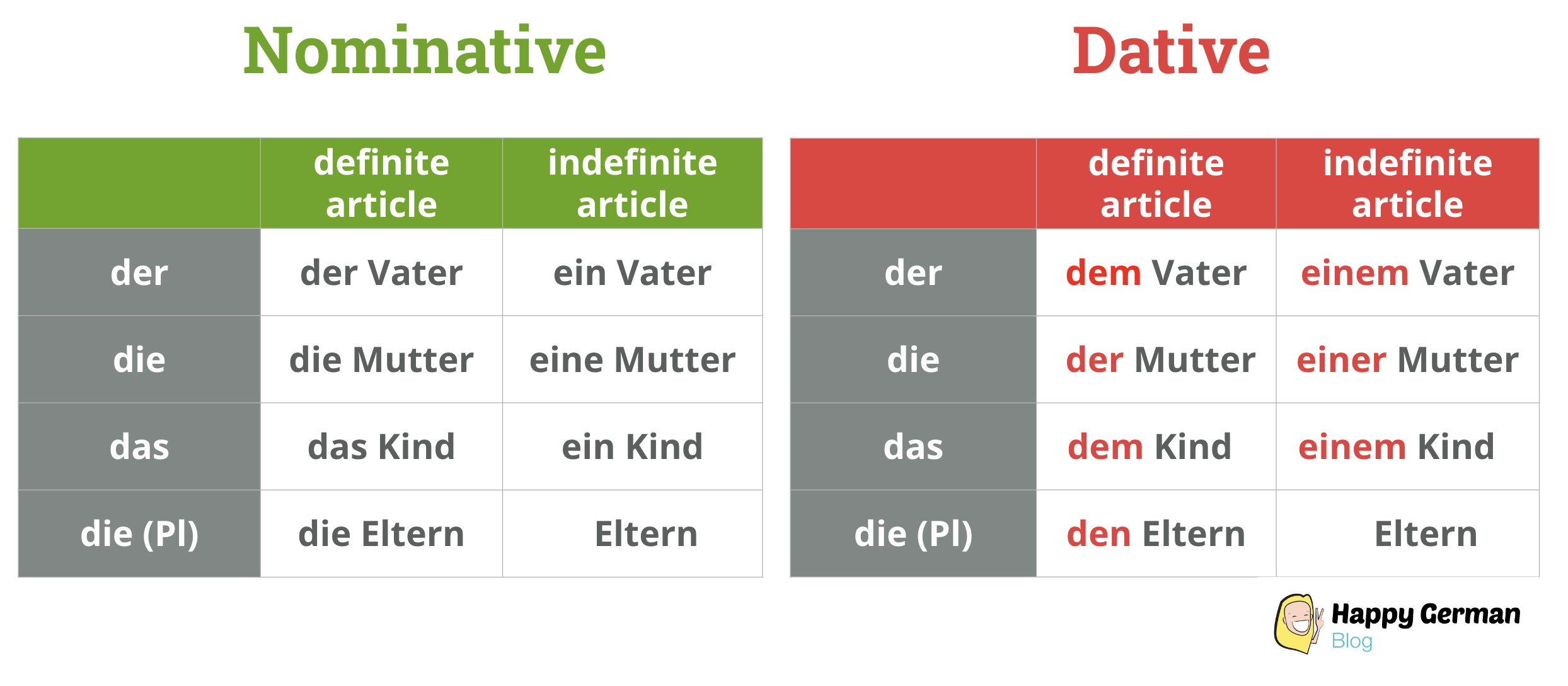
Oh, and here is the table with the changes to the articles for reference.

Prepositions That Only Take The Accusative
Alright, my dear student, the party isn’t over yet. We’ll let loose when we get to the two-way prepositions.
There are certain prepositions that only take the Accusative case.
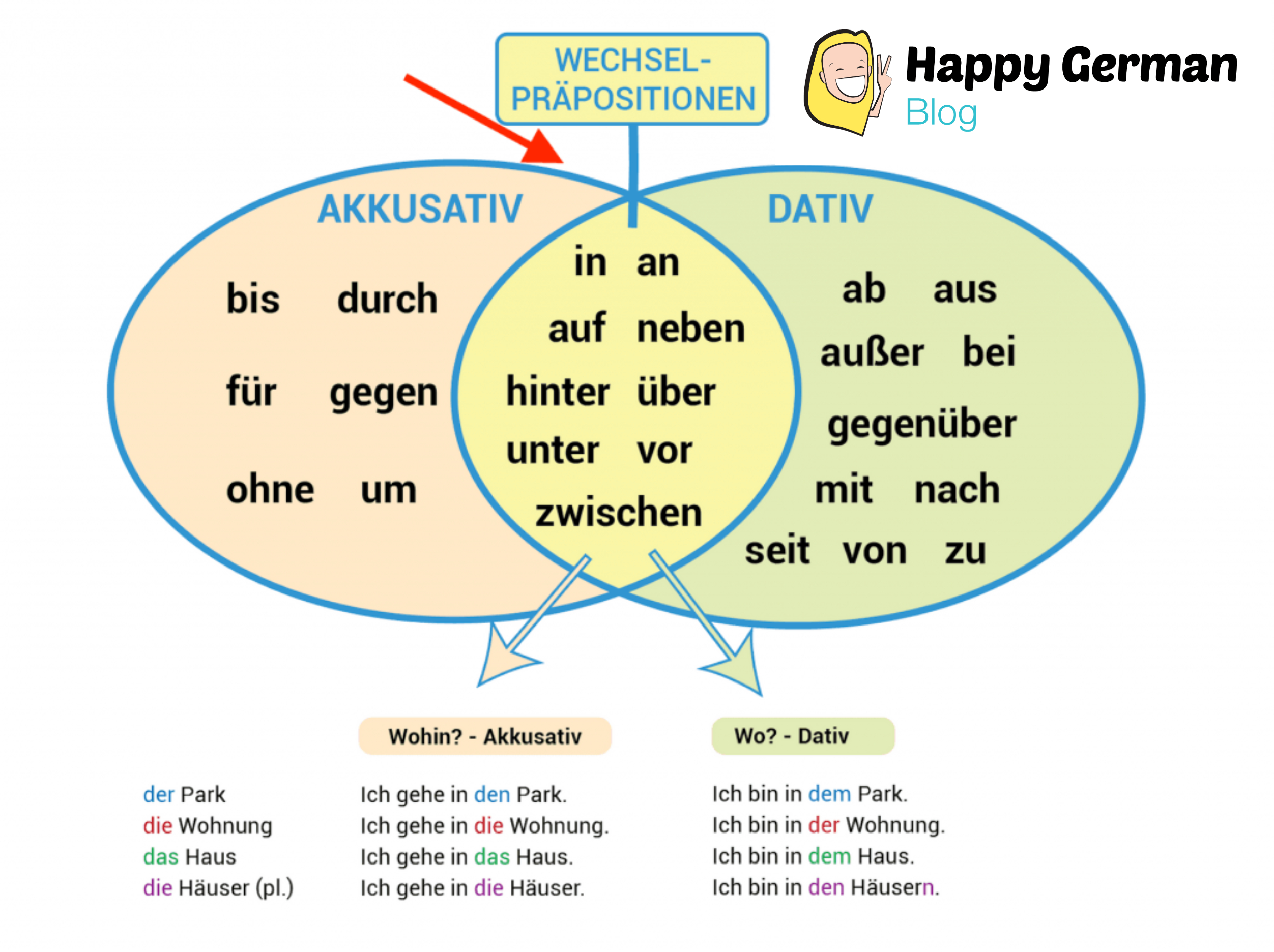
Here’s a funny acronym to help you remember them: DOGFUB.

Was in aller Welt ist ein DOGFUB?
Here they all are - the DOGFUB prepositions - with an example each:
- durch (through): Das Auto fährt durch den Tunnel. (The car is driving through the tunnel.)
- ohne (without): Wir verreisen ohne dich. (We’re going on a trip without you.)
- gegen (against): Ich laufe gegen den Baum. (I’m running against the tree.)
- für (for): Die Blumen sind für ihn. (The flowers are for him.)
- um (around): Der Hund läuft um den Baum. (The dog is running around the tree.)
- bis (until): Bis nächsten Montag. (See you next Monday. Literally, you’re saying: Till next Monday.)
Let’s step outside for a minute and catch some fresh air. 

Shake off any tension you might have, relax your muscles and watch Anja’s video about Accusative prepositions. It’s fun and it’ll help you to memorize them.
Prepositions That Only Take The Dative
I feel recharged, how about you? I hope you’re full of energy again, because things are getting interesting. The following prepositions always require the Dative case only, which is pretty nice. Unfortunately, there is no funny acronym to memorize them. If there were, it would probably sound like a cat walking on a piano. 
- ab (from ... on): Ab nächster Woche. (Starting from next week. Or: From next week on.)
- aus (from, out of): Er kommt aus der Türkei. (He is from Turkey. Note that “die Türkei” is an exception. Usually, names of countries do not take articles.)
- außer (except, but): Außer meinem Freund kenne ich niemanden auf der Party. (I don’t know anybody at the party, except my friend.)
- bei (at, near): Die Spielsachen sind bei meiner Mutter. (The toys are at my mother’s.)
- gegenüber (across): Sie wohnt gegenüber der Tankstelle. (She lives across the petrol station.)
- mit (with): Ich fahre immer mit dem Bus. (I always take the bus. Literally: I always drive with the bus.)
- nach (after): Nach der Pause haben wir Deutsch. (After the break we have German.)
- seit (since): Seit letzter Woche ist er krank. (He’s been sick since last week.)
- von (from, by): Der Brief ist von meinem Vater. (The letter is from my father.)
- zu (to): Sie fahren zu ihren Eltern. (They are going to their/ her parents'.)
Two-Way Prepositions (Wechselpräpositionen) That Take The Dative Or The Accusative
Alright, you little party monsters, now it’s time for the most interesting part of our session. We’re going to talk about prepositions that can take either the Dative or the Accusative case, depending on the situation. They are called “Wechselpräpositionen” (two-way prepositions). Some might consider them bisexual, if you know what I mean... 


How do we know when to apply the Accusative or the Dative case with these prepositions? Here are a couple of hints:
- To begin with, all “two-way prepositions” are used as local prepositions (as opposed to temporal prepositions, for instance).
- With local prepositions we say
- where someone or something is,
- where someone or something is moving or being moved to, from a given point A to point B.
When we talk about a movement, from point A to B, we apply the Accusative case. Here’s an easy way to remember:
ACtive -> ACcusative
In order to find out, if some ACtion is involved, you may ask yourselves the magic question,
“Wohin” (where to) “... gehe ich?” (... am I going?)
Now you know that a movement (ACtion) is involved.
Let’s get more practical and have a look at some examples:
- in (in, to) - Ich gehe in den Zoo. (I’m going to the zoo.)
- an (to, on, at) - Er fährt an den See. (He drives to the lake.)
- auf (on, on top of) - Wir klettern auf den Baum. (We’re climbing - on top of - the tree.)
- neben (next to) - Sie stellt den Stuhl neben den Tisch. (She puts the chair next to the table.)
- hinter (behind) - Der Ball fällt hinter die Kiste. (The ball falls behind the box.)
- über (above, over, across) - Das Flugzeug fliegt über den Ozean. (The plane is flying across the ocean.)
- unter (under, below) - Die Katze läuft unter den Tisch. (The cat runs under the table.)
- vor (in front of) - Der Junge springt vor den Fernseher. (The boy is running in front of the TV.
→ It means that the boy was somewhere else and moved in front of the TV from there. From A to B, remember?)
- zwischen (between) - Ich setze die Pflanze zwischen den Kaktus und den Apfelbaum. (I’m putting the plant between the cactus and the apple tree.)
As you can see, in all of the examples there is some kind of action involved, a movement from point A to point B.

James klettert auf den Tisch.
(James is climbing onto the table.)
Now, when we look at the Dative case with the same prepositions, the major difference is that we’re talking about a static situation. In the post about the Dative case we named it after Jabba the Hutt (German: Jabba, der Hutte), who is totally passive and doesn’t move.
And before I forget, there is also a magic question that we can use here:
“Wo” (where) “... bin ich?” (... am I?)
Here are the examples with the same prepositions followed by the Dative case:
- in (in) - Ich bin mit Freunden im Zoo. (I’m at the zoo with friends. Note: in + dem = im)
- an (on, at) - Er liegt am See. (He’s lying at the lake. Note: an + dem = am)
- auf (on, on top of) - Wir sitzen auf dem Baum. (We’re sitting in the tree. Literally: ... on top of the tree.)
- neben (next to) - Der Stuhl steht neben dem Tisch. (The chair is standing next to the table.)
- hinter (behind) - Der Ball liegt hinter der Kiste. (The ball is lying behind the box.)
- über (above, over) - Das Flugzeug befindet sich über dem Ozean. (The plane is located above the ocean.)
- unter (under) - Die Katze schläft unter dem Tisch. (The cat is sleeping under the table.)
- vor (in front of) - Der Junge steht vor dem Fernseher. (The boy is standing in front of the TV.)
- zwischen (between) - Die Pflanze steht zwischen dem Kaktus und dem Apfelbaum. (The plant is standing between the cactus and the apple tree.)

Hallo, siehst du mich? Ich bin auf dem Baum!
Hello, can you see me? I'm in the tree. (Or literally: on top of the tree.)
Great job! What a smart cookie you are. As you can see, the prepositions can be a little tricky at first, but once you understand the concept they’re not difficult at all.
Two keys to understanding
whether to use the Accusative or the Dative
after the two-way prepositions:
- If there is movement (ACtion!) involved, use the Accusative.
- If there is a static situation (telling you where someone or something is), use the Dative.

Would you like to recap once more? Let’s watch the video below where Anja is playing hide and seek  , using the above prepositions. After that, we’ll refill our party cups for the last section of the post. Enjoy!
How To Know When To Use Dative And/ Or Accusative
Looks like the preposition party is starting to wind down. But let’s not leave yet. Let’s look at how to tell which cases to use when. I’ll give you a set of 3 useful questions. If you use these questions, then I promise you will hardly have any problems with these two cases!
Question 1: Is There A Preposition?
Now that we've covered the topic of prepositions, you are one step closer to being a master of the Accusative and Dative after prepositions.
Wanna take a little test? Don’t worry, you're not being graded.
Let’s say you want to use the preposition “mit”. Which case do you apply? Exactly, the Dative case.
In a dictionary, the entry might look like this:


Question 2: Which Verb Are You Using?
Remember, certain verbs are followed by certain cases. We covered this in the blog posts about the Accusative and the Dative cases. Feel free to go back to the posts for review. If you are not sure which case to use after a certain verb, please check a dictionary:
In a dictionary you will find the following abbreviations:
- “jdn” is short for “jemanden” (somebody), which indicates the Accusative case
- "etw" is short for "etwas" (something), which usually indicates the Accusative case
- “jdm” is short for “jemandem” (somebody), which indicates the Dative case
So, in the example below you can see that "geben" usually requires the Dative and Accusative:
- Ich gebe dem Mann einen Apfel. (I give an apple to the man.)
Check the image below of what it looks like in a dictionary:

There are other verbs like this:
- empfehlen (to recommend): Der Kellner empfiehlt mir einen vegetarischen Burger. (The waiter recommends a veggie burger to me.)
- zeigen (to show): Ich zeige dir meine Stadt. (I show my city to you. Or: I show you my city.)
And, of course, there are verbs that are followed by one case only. Remember, the majority of verbs that take an object take it in the Accusative case.

Ich habe ihr einen Apfel gegeben.
(I gave an apple to her.)
After verbs with two objects,
very often the person (living object) is in the Dative case,
while the thing (non-living object) is in the Accusative case.
Question 3: Is There A Prepositional Verb?
Just like in English, there are verbs in German that take certain prepositions, they are like a fixed combination, they come in a pack. Unfortunately, you will have to memorize these combinations, OR alternatively, look them up in a dictionary.
Let’s check a few examples, right?
- glauben an (+ Accusative) - to believe in someone / something:
→ Ich glaube an meinen Traum. - I believe in my dream.
- teilnehmen an (+ Dative) - to take part in something:
→ Ich nehme an einem Wettbewerb teil. - I am taking part in a competition.
- denken an (+ Accusative) - to think about/ of someone/ something:
→ Ich denke an meinen Vater. - I am thinking of my father.
→ Ich denke an meine Arbeit. - I am thinking of my job.
Here is what it might look like in a dictionary.


Well done, you! We're almost there.
Because now it's time to test yourselves on all the interesting things you have learned here about prepositions followed by the Accusative and/ or Dative case.