Welcome to another lesson on adjectives! Today, we’re going to learn how to use German adjectives with cases.
Now, I know what you’re thinking… Didn’t we already do this? Wasn’t there something about adjective endings for all of the different cases and then another thing about cases that go with different prepositions for adjectives?

Adjektive mit Fällen. - Haben wir das nicht schon gestern gemacht?
I’m glad you remembered, good work! That was only part of it, though. Who wouldn’t want some more after such fun lessons? This, right here, is the grammatical version of dessert! 
What Do German Cases Have To Do With Adjectives?
Well, sometimes adjectives go with specific cases, even without any specific verbs or prepositions that tell us what to do. - In case you want to review the cases, go to our post on "The Four German Cases Made Simple".
Where To Put Adjectives When Cases Get Involved
When an adjective goes with a specific case, the noun in the specific case will normally be in front of the adjective. That’s important, because the sentence structure is different when we have adjectives with prepositions followed by an object in a specific case.
That might sound a little confusing, so let’s check a few examples.
Adjectives With Prepositions
- gut sein in (to be good at) - Sie ist gut in Mathematik. (She is good at math.)
- fertig sein mit (to be done with) - Bald ist er fertig mit der Reparatur. (Soon he will be done with the repairs.)
- begeistert sein von (to be thrilled about) - Katie ist von dem Essen begeistert. (Katie is thrilled about the meal.)
- vorbereitet sein auf (to be prepared for) - Katie ist auf den Test vorbereitet. (Katie is prepared for the test.)
→ As you can see in the first one, the object noun ("Mathematik") is right after the preposition ("in"). And it's the preposition that that tells us what case to use.
→ Since the preposition is doing all the hard work, the position of the adjective is more flexible: it can go before the preposition ("gut in", fertig mit") or after the object ("von dem Essen begeistert").
→ In the first three examples above, all combos of adjectives and prepositions are followed by an object in the Dative case. As we can see, the last example uses the Accusative case. It's important we point this out because the prepositions "in" and “auf” could go with either the Accusative or the Dative case. You will have to learn which adjectives and prepositions go with which cases.
But we are here to find out about...
Adjectives Without Prepositions
- sicher (certain) - Er ist des Sieges sicher. (He is certain of victory.)
→ This adjective combines with an object in the Genitive case. These combinations are mostly used in written and formal German. You will find more of them further down in this post.
- dankbar (thankful) - Sie ist ihr dankbar. (She is thankful to her.)
→ Combinations of adjectives and objects in the Dative case—as in the given example—are rather common and used in both spoken and written German. Of course, we have a list of more of them for you.
- gewohnt (used to) - Katie ist das Wetter gewohnt. (Katie is used to the weather.)
→ This is an example of adjective plus object in the Accusative case. Find out more a little further down.
When there is no preposition, the object in the associated case goes before the adjective, though not always right in front. For example:
- Sie ist ihr dankbar. (She is grateful to her.)
- Sie ist ihr sehr dankbar. (She is very grateful to her.)
- Sie ist ihr nicht dankbar. (She is not grateful to her.)
- Sie ist ihr überhaupt nicht dankbar. (She is not at all grateful to her.)
The more basic sentence has “ihr” right in front of “dankbar”. However, any additional words that modify the adjective—in this case “dankbar”—will go between the two.
Adjectives without prepositions...
- ...have "their" objects in front of them.
- Any words modifying the adjective go between object and adjective.

Das Einhorn ist den Regen gewohnt.
The unicorn is used to the rain.
How To Figure Out Which Case To Use
When you’re trying to think and make sentences directly in German, you’ll mostly just need to memorize what cases an object should have with a certain adjective.
That’s the bad news.
Fortunately, if you’re reading this article, you also speak English, and that can help us a little bit.
If you know the English sentence for what you want to say in German, you can often guess which case you need to use.
Convenient, right? We’ll add the tricks for each grammatical case below, along with the examples. Of course, these only help us to make better guesses, and they only work when the German and English sentences are built in a similar way.
Ok, now that you’ve had the disclaimer, let’s get to the examples!
Adjectives With The Dative Case
Adjectives mostly combine with objects in the Dative case, and they’re very commonly used in everyday conversation.
- bekannt (known to) - Die Geschichte ist allen bekannt. (The story is known to everyone.)
- behilflich (helpful to) - Kaffee ist mir beim Aufwachen immer sehr behilflich. (Coffee is always very helpful to me when waking up.)
- bewusst (aware of) - Ihr war es nicht bewusst. (She wasn’t aware of it. Literally: It wasn't clear to her.)
- angenehm (comfortable with) - Die Situation war mir nicht angenehm. (I wasn’t comfortable with the situation. Literally: The situation wasn't comfortable to me.)
- böse (mad at) - Sie war ihm nicht böse. (She wasn’t mad at him).
- egal (irrelevant) - Ihr ist es egal. (It doesn't matter to her. Literally: It's irrelevant to her.)
- wichtig (important) - Familie ist ihm wichtig. (Family is important to him.)
- dankbar (thankful) - Sie ist ihr dankbar. (She is thankful to her.)
- klar (clear) - Die Konsequenzen sind ihm klar. (The consequences are clear to him.)
Sneaky trick: If the English version of your sentence uses prepositions like at, to and from after the adjective, then you’ll often use the Dative case in the German version. As you can see, this sneaky trick works with most of the given examples. However, it doesn't work with the ones where we had to give the literal translations.
Extra Tip: The following combinations of adjective and the verb "tun" are very common, and a source of mistakes when you translate from English. So, you might as well add them to your list:
- leid tun (to be sorry) - Es tut mir leid. (I'm sorry.)
- weh tun (to hurt) - Mein Kopf tut mir weh. (My head is hurting.)
→ As you can see, both of them combine with the object in the Dative case, usually the pronouns in the Dative case. Check out the paragraph "Personal Pronouns In The Dative Case" in our Dative post, if you want to review them.

Ich glaube, er ist mir ein bisschen böse.
I think, he's a little mad at me.
Adjectives With The Accusative Case
There are relatively few adjectives that go with objects in the Accusative case, but those few are very common.
- voraus (ahead) - Sie ist immer einen Schritt voraus. (She is always a step ahead.)
- leid (fed up) - Ich bin meinen Schnupfen so leid. (I am so fed up with my cold.)
- gewohnt (used to) - Katie ist das Wetter gewohnt. (Katie is used to the weather.)
- wert (worth) - Das Auto ist das Geld wert. (The car is worth the money.)
- los (rid) - Gogo ist den alten Rechner endlich los. (Gogo is finally rid of the old computer.)
- schuldig (due, owed) - Gogo ist Bobbi einen Kaffee schuldig. (Bobbi is due a coffee from Gogo.)
Sneaky trick: If the English version of the sentence has no preposition with the adjective, then the object noun is likely to be in the Accusative case. As you can see, this works for some of the given examples.
Adjectives With The Genitive Case
Many of the adjectives that are used with a Genitive object are very formal, poetic, or so old and outdated that you only need to recognize them to read old texts – something like an old Bible translation. 
Normally, they're not used in conversation. We’ll mark those with an asterisk (*).
- *habhaft (in possession) - Der Dieb wollte des Goldes habhaft werden. (The thief wanted to take possession of the gold.)
- *ansichtig (in view) - Er wurde der Sonne ansichtig. (He caught sight of the sun.)
- *kundig (skilled) - Er ist des Lesens nicht kundig. (He isn’t skilled in reading.)
- *bedürftig (in need) - Pflanzen sind des Regens bedürftig. (Plants are in need of the rain.)
- *würdig (worthy) - Er ist ihrer Aufmerksamkeit nicht würdig. (He isn’t worth her attention.)
Others are more common, but usually still more formal than other ways of expressing the same idea.
- bewusst (aware) - Sie ist sich der Gefahr bewusst. (She is aware of the danger.)
- sicher (certain) - Er ist des Sieges sicher. (He is certain of victory.)
- mächtig (mighty, knowledgable) - Sie ist der Aufgabe mächtig. (She is up to the task. Literally: She is knowledgable about the task.)
- gewachsen (grown) - Sie sind der Herausforderung nicht gewachsen. (They aren’t up to the challenge.)
- gewiss (certain) - Sie ist sich dessen gewiss. (She is certain of it.)
Sneaky trick: If the English version of our sentence tends to use “of” with the adjective, then the German version often uses a Genitive object instead. Again, this works for some of the given examples.
So, what happens, if our sneaky tricks don't work? Well, in that case you will always find help in a dictionary.
Look Up Adjectives Combining With Certain Cases In A Dictionary
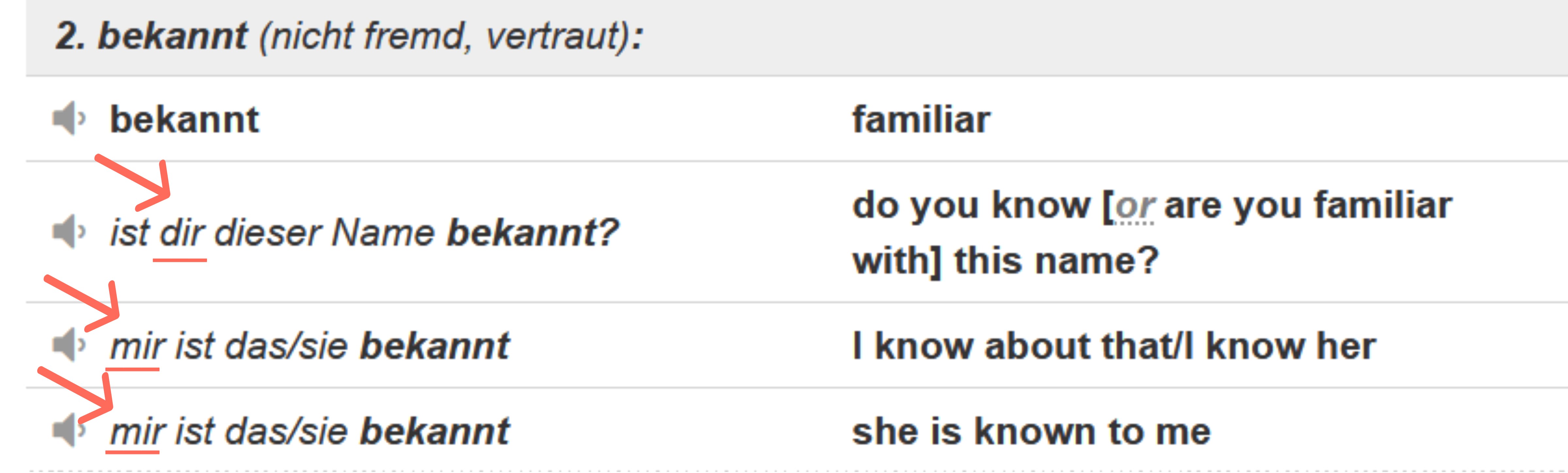
When you check your dictionary for adjectives and what cases they combine with, the information will usually not show in the first entry. That's because most adjectives are usually used to describe a noun. So, in the first entries in the dictionary you will find the more literal translation and common use.
Let me show you how to find the combos of adjectives and their respective cases:

→ What this dictionary entry shows, is that you have to scroll down to information number "2.". By recognizing that the pronouns "dir" (to you) and "mir" (to me) are used in their Dative forms, you will have the key to using this combo correctly. You will find similar entries for all adjectives with the Dative case.
Let's check another example:

→ What the above dictionary entry shows, is that you have to scroll down to information number "5.".
→ The abbreviation "geh" right after the adjective "mächtig" (mighty, knowledgable) tells you that this is sophisticated language, so it's only used in very formal conversation or in written German.
→ The next abbreviation is "Gen", which you can easily relate to the case, the Genitive case. Also, they use "einer S.", which is short for "einer Sache" (about a thing - about something), which is a further clue to the use of the Genitive case.
In short, ...
When you look up adjectives and their respective cases in a dictionary, you’ll have to work a little to find the information you need:
- Scroll down till you find objects (nouns, pronouns) in the Dative or Accusative case.
- Look for abbreviations of the cases: Gen = Genitive, Dat = Dative, Akk = Accusative.
Whew! Congratulations, you’ve made it all the way to the end. Now, in order to remember how the combinations of adjectives and their cases work, we suggest you go through our little quiz.